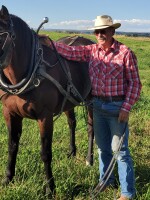
Over last weekend, I received about three tenths of an inch of precipitation on my farm north of Cortez, which won’t alleviate the dry conditions in the fields and pastures. The latest drought monitor indicates that most of Colorado is now experiencing moderate to exceptional drought. Here in the Four Corners region, we’re sharing our severe and extreme drought conditions with New Mexico, Arizona and Utah. At this point, water managers are predicting that unless weather patterns shift to wetter than normal conditions, farmers are facing irrigation water shortages, due in part, to the record-breaking high temperatures in March that caused the peak snowpack runoff to occur about two months early.
Goats are farm animals that are often accused of eating almost anything. I recall a farm publication cartoon that depicted a goat eating laundry off of a clothes line. They thrive on grazing plants that cows won’t touch and handle steep terrain like, well, a mountain goat. So these animals are often brought into areas where weeds are a problem, but herbicides or mechanical methods can’t be used to control them. Lately, some enterprising goat herders have been supplying herds of goats to ski resorts to graze the steep ski runs during the summer, and to control problem weeds in urban environments, where other control methods can’t be used. But the main problem with using goats for these tasks is keeping them on site. A while ago, I talked about virtual fences that some Four Corners ranchers are using to keep their cows contained on Forest Service or Bureau of Land Management grazing leases. The system works with battery powered halter collars that cows wear around their necks, that interpret GPS coordinates transmitted to a GPS transceiver, that are in turn, communicated back to the collar on the cow. If the animal approaches the virtual fence boundary that's been designated by a rancher, a signal warns the cows first, but if the cow continues to move into the virtual fence boundary, the collar generates an electric shock similar to what a conventional electric fence would deliver. Now, this technology is being adapted for goats and sheep, and is working quite well for those enterprising goat herders who often had a hard time keeping their critters on task and contained, while mowing down unwanted vegetation.
The American Farm Bureau Federation is warning that high fertilizer prices, caused by curtailments of fertilizer shipments from the Middle East, are adding financial pressures to the U.S. farm economy. A recent Farm Bureau survey of more than 5,700 farmers in every U.S state and Puerto Rico found that 70% of the respondents believed that they won’t be able to afford the fertilizer they need for optimum crop yields this growing season. The survey also determined that many of the respondents are already making tough decisions by cutting back on fertilizer use or reducing planted acres due to higher fuel costs. According to AFBF economist Faith Parum, the survey found that about 60% of farmers predicted their finances will be worse than in previous years, while 36% expect that conditions to hold steady. Only 6% foresee any financial improvement.
Dry Weather is also an impediment to farmers who produce hard red winter wheat in Texas, Nebraska, Oklahoma, Kansas and Colorado. Over 50% of these producers expect that they will have to abandon as much as 50% of their crop acres due to drought this summer.
George Washington wrote, “I would rather be on my farm than be emperor of the world.”